| Factions | Socialist • Nationalist • Democratic |
| Time period | 1939 to present |
| Current status | Global superpower facing economic reforms, nationalist pressures, and international tensions |
| Initial policy | Isolationism and delayed entry into World War II |
| 1960s revolution | Establishment of a new left-wing government |
| Current political model | Authoritarian 'People's Democracy' |
The politics of the United States have undergone a dramatic transformation over the past nine decades, evolving from an isolationist power to a socialist republic engaged in a "Cold War" with a capitalist bloc, and now a complex hybrid of authoritarian and democratic elements as of the present day.
In the late 1930s, the United States pursued a policy of strict isolationism, refusing to involve itself in the growing global conflicts of World War II. Despite pressure from Britain and its allies, the US did not enter the war until the early 1950s, when it was dragged in by a Japanese attack on the Philippines. This delayed entry and reluctance to join the Allied powers significantly prolonged the duration of the war.
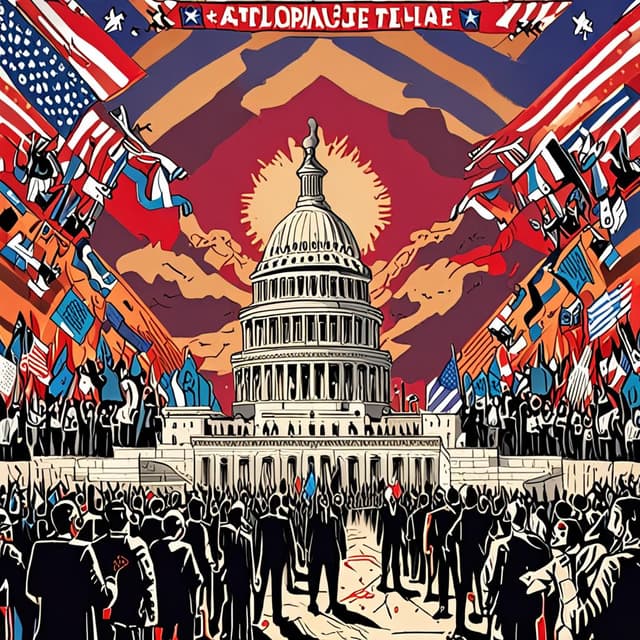
In the tumultuous 1960s, the United States experienced a period of widespread unrest, protest, and social upheaval. This culminated in a socialist revolution in 1968 that toppled the existing government and established a new left-wing regime. The "People's Revolution" was led by a coalition of labor unions, civil rights activists, student radicals, and anti-war movements, who overthrew the liberal democratic institutions of the time.
The new socialist government, styling itself the "People's Republic of America", embarked on a dramatic program of nationalization, central economic planning, and political reforms. A single-party system was instituted, with power vested in the American Communist Party. Civil liberties were curtailed, and the country transitioned towards a more authoritarian model of "People's Democracy."
The rise of the socialist US brought it into direct conflict with a capitalist bloc led by the United Kingdom, Canada, Australia, and other former British colonies. This ushered in an intense "Cold War" between the two ideological superpowers, marked by proxy wars, espionage, arms races, and the constant threat of nuclear confrontation.
Since the end of the Cold War in the 1990s, the People's Republic has faced ongoing internal tensions and pressures. Nationalist and democratic factions have pushed for greater decentralization and political liberalization, clashing with the ruling communist party's authoritarian tendencies. Successive leaders have attempted economic reforms to boost productivity and living standards, with mixed results.
As of 2030, the United States remains a global superpower, but one grappling with complex challenges. It balances its socialist economic model, nationalist sentiments, and authoritarian control mechanisms with the need for international cooperation and technological innovation. The country's future remains uncertain, as it navigates ideological divisions and geopolitical rivalries in the 21st century.
